
FSN50 vs FSC50 Rain Gun: Turbine or Impact for Your Irrigation Block?
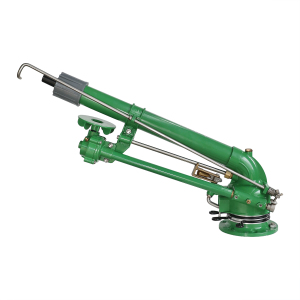
The one-line decision rule: if your block can hold 0.2–0.7 MPa and the pattern has to repeat the same way on every rotation, specify the FSN50 turbine rain gun. If supply at the gun drops as low as 0.15 MPa and maximum reach across a wide block matters more than a fine-grained pattern, specify the FSC50 impact rain gun. Both are FOISON Sprinkler rain guns sharing a 24° spray angle, 360° adjustability and an aluminium, nylon and stainless steel build — so the decision turns on mechanism, pressure and field geometry, not on quality tiers.
This is a head-to-head decision article for the point where a specification gets locked: distributors building a rain gun line, farm managers ordering guns for one specific block, and project engineers who have to commit a pump curve, a pipe diameter and a spacing plan to a single model. It compares only two products, the FSN50 and the FSC50, and it deals with the questions that actually change an order: where each mechanism wins, what the pressure and throw figures mean in the field, and how to validate the choice before the container is loaded.
The Real Decision Is Hydraulic, Not Cosmetic
Rain guns are often compared as if they were interchangeable hardware with different labels. They are not. A rain gun is the last component in a hydraulic chain that starts at the pump and ends at the root zone, and the drive mechanism inside the gun determines how the rest of that chain has to be built.
Two failure patterns account for most poor rain gun specifications:
- Under-pressured turbine specification. A turbine gun depends on an internal turbine being driven hard enough to rotate the gun consistently. The FSN50 is rated from 0.2 MPa upward. A block that only delivers 0.15 MPa at the hydrant sits below the bottom of that band, and the field result no longer matches the design assumption behind the spacing plan.
- Over-specified impact installation. The FSC50 impact gun starts at 0.15 MPa because its rotation energy comes from the jet striking the swing arm. Where a block already runs comfortably in the middle of the pressure band and the priority is a repeatable wetted circle, the turbine mechanism is the cleaner engineering answer.
There is a commercial version of the same problem. A distributor listing only one of the two mechanisms can serve only one half of the market — either the low-head segment or the uniformity-critical segment. Because the FSN50 and the FSC50 come from the same FOISON Sprinkler product platform and share their construction materials, carrying both is usually a catalog decision rather than an inventory decision.
Where Rain Guns Sit in the Irrigation Market
Rain guns are a mature category inside a market that keeps expanding. The global sprinkler irrigation market was valued at USD 3.04 billion in 2025 according to Grand View Research. The broader smart irrigation market was estimated at USD 2.2 billion in 2025 and is projected by IMARC Group to reach USD 6.2 billion by 2034.
Demand is geographically concentrated. Grand View Research places Asia Pacific at a 36.2% revenue share of the agricultural irrigation machinery market in 2025, with China as the leading country — the same region where both guns in this comparison are manufactured.
Two reference points are worth carrying into any rain gun specification. ISO 7749-1:1995 specifies the design and operational requirements for rotating sprinklers used in agricultural irrigation, which gives buyers a framework for structuring their own acceptance questions. On the trade side, mechanical appliances for agricultural or horticultural use for projecting, dispersing or spraying liquids generally fall under HS code 842482, the classification to check when import documentation is prepared.
FOISON Sprinkler — Xuzhou Foison Sprinkler Irrigation Equipment Co., Ltd — is a manufacturer of irrigation spray guns and irrigation equipment, founded in 2013 and located in Xuzhou City, Jiangsu Province, China, a key irrigation equipment base. The company operates a 30,000 m² factory with 135 staff and an annual output of 200,000 units, and exports about 70% of production to the EU, Africa, Australia, New Zealand, South East Asia, Mid Asia, Mid East and South America. Its core products are turbine spray guns, impact guns and irrigation systems. In the company's own comparison material, sprinkler irrigation is positioned as saving at least 50% of energy and cost compared with normal irrigation in water-scarce areas, with a low failure rate and easy installation and maintenance.
How Each Mechanism Works — and What the Specs Actually Say
Both the FSN50 and the FSC50 are large rain guns. The difference is what turns them.
Turbine drive: FSN50
The FSN50 is a turbine-driven rain gun. Water entering the gun drives an internal turbine, and the turbine rotates the gun body continuously. Because rotation is produced by the mechanism rather than by the impact energy of the jet, the gun sweeps at a controlled rate — which is the mechanism-level reason turbine guns are chosen where a stable, uniform wetted pattern is the design target.
Rated performance for the FSN50 is 0.2–0.7 MPa with a throw of 26–53 m. FOISON lists 20 mm and 26 mm nozzles as examples for this gun. In practice, pressure and nozzle diameter are the two variables a buyer sets: the nozzle defines the flow and droplet size the gun is fed with, and the operating pressure defines how far and how forcefully that water leaves the nozzle. The 26 m to 53 m spread is a working envelope across the pressure band, not a single fixed figure.
Impact drive: FSC50
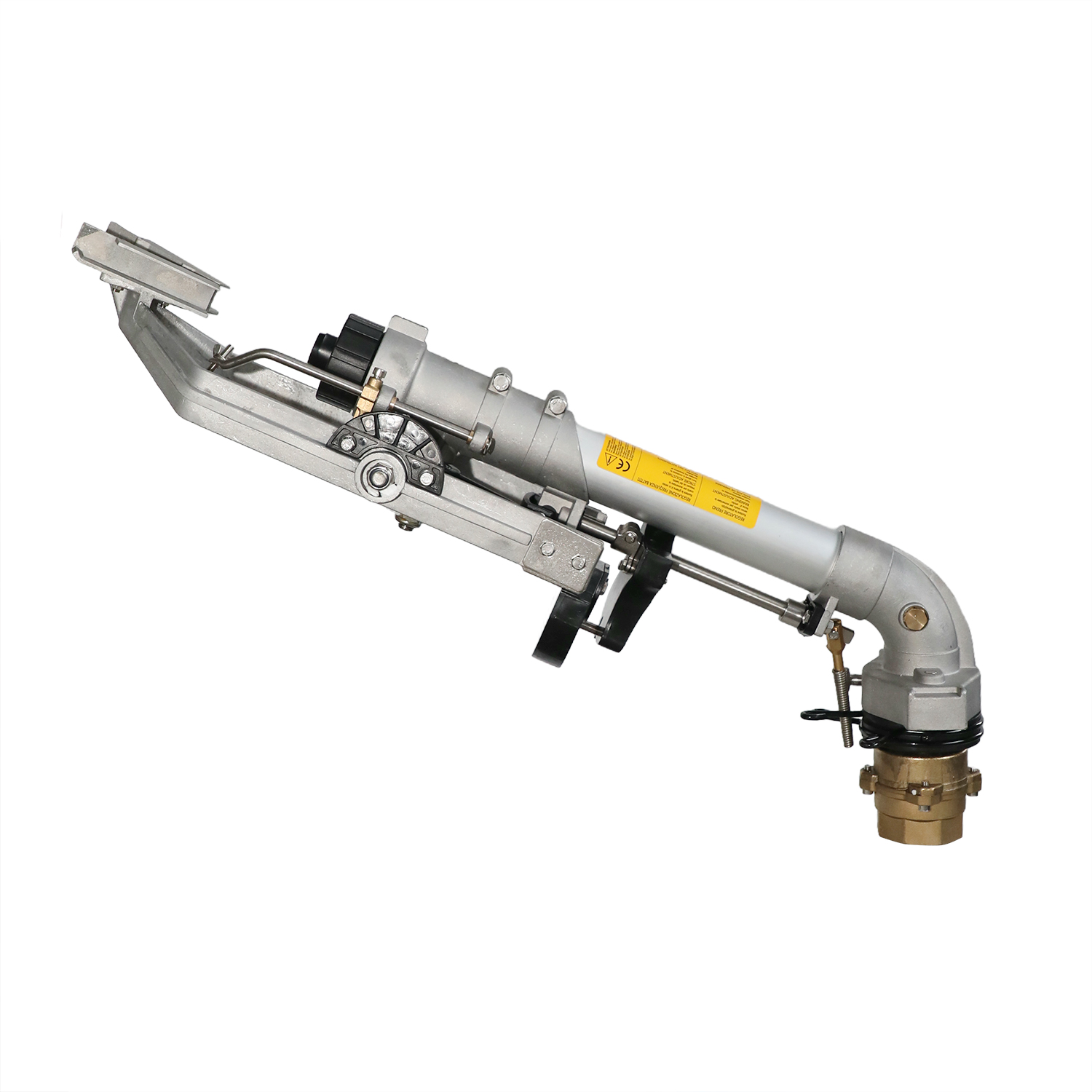
The FSC50 is an impact-driven rain gun. A swing arm interrupts the jet, and the reaction of the jet against the arm produces rotation. Because the jet itself supplies the rotation energy, the mechanism can start and keep rotating at lower pressure — which is why the FSC50 is rated from 0.15 MPa and runs to 0.7 MPa, with a throw of 23–56 m.
One concrete figure from the specification explains the gun's field role: with a 14 mm nozzle at 0.15 MPa, the FSC50 delivers 9 m³/h. A block with a low-head source can therefore hold per-gun flow at 9 m³/h, run several guns from one line and still throw 23 m or more. The low-pressure end of the range is genuinely usable rather than a fallback. At the top of the pressure band the FSC50 reaches up to 56 m, which is further than the FSN50's 53 m.
What both guns share
The shared specification matters as much as the differences, because it is what makes a mixed program practical:
- 24° spray angle. Both guns throw a wide, relatively flat jet, so gun spacing, wind exposure and edge-of-block pattern distortion are worked out the same way for both models.
- 360° adjustability. Both can run full-circle or be adjusted to cover a sector, which is what makes a single gun usable at a block corner or along a boundary.
- Aluminium, nylon and stainless steel construction. The two guns share the same material family, so a distributor carries one spare-parts logic and service teams learn one product group.
Practical reading: the FSN50 and the FSC50 are not competitors in the sense that one replaces the other. They cover two different pressure realities. Buying both for a distribution program removes the risk of prescribing the wrong mechanism to a customer whose water supply you cannot change.
Step-by-Step: Specifying FSN50 or FSC50 for One Block
Work in this order. The sequence matters, because a decision taken at step two changes the answer at step five.
- Measure pressure at the hydrant while the block is running. Not nameplate pressure, and not static pressure. The number that decides the mechanism is the pressure available at the gun inlet with the block's guns operating. Compare it against the FSN50 floor of 0.2 MPa and the FSC50 floor of 0.15 MPa.
- Map the block and set gun spacing from throw radius. The FSN50 spans 26–53 m and the FSC50 spans 23–56 m. Spacing is normally derived from throw radius, so a block that needs the longest possible reach at the top of the pressure band points toward the FSC50.
- State the uniformity requirement in writing. If the agronomy depends on the same wetted pattern repeating rotation after rotation, the continuous turbine rotation of the FSN50 is the mechanism to specify. If the block can accept the pattern signature of an arm-driven gun in exchange for low-pressure operation, the FSC50 is the fit.
- Select nozzle diameter against available flow. FOISON lists 20 mm and 26 mm nozzles for the FSN50; for the FSC50, a 14 mm nozzle at 0.15 MPa gives 9 m³/h. The nozzle is where a theoretical pressure band becomes a real flow number for your pump.
- Check the pump curve at simultaneous demand. Multiply per-gun flow by the number of guns running together, then compare with what the pump can hold. This is the step where a gun that looks better on paper becomes the wrong gun, because the pump cannot hold the chosen mechanism's minimum pressure.
- Set arc and spray angle before installation. Both guns use a 24° spray angle with 360° adjustability, so boundary and corner coverage is a setting decision. Fix it at commissioning, not after the first dry strip appears.
- Match materials to water quality and service conditions. Both guns use aluminium, nylon and stainless steel. Where water carries abrasive solids, nozzle wear is the item to monitor, because it changes flow across a season.
- Validate with sample units, then standardize. Run sample guns on the block through a full cycle before committing a full order. FOISON products are accepted through a pre-shipment test procedure, so the validation that matters most is on your own field, followed by acceptance inspection on the shipment.
Which Block Suits Which Gun
The fastest way to apply this comparison is to match the gun to the constraint that is hardest to change. Pressure is usually the hardest constraint; spacing comes next; crop sensitivity to pattern is third.
- Low-head or gravity-fed source (0.15–0.2 MPa at the gun): FSC50. The impact mechanism is rated from 0.15 MPa, and a 14 mm nozzle at that pressure still moves 9 m³/h.
- Large open block where reach drives gun count: FSC50. Its 56 m upper throw is the longest of the pair, which reduces the number of guns and hydrant points required.
- Block running 0.2–0.7 MPa with a uniform-coverage requirement: FSN50. Its rotation is set by the turbine rather than by jet impact, which is why it is specified where the wetted pattern must repeat consistently.
- Block with a 26–53 m design radius and a supply that dips during peak hours: FSN50, specified with 20 mm or 26 mm nozzles and checked against the pump curve at the worst-case pressure of the day.
- Vegetable, fruit, plant and tea farms: either gun, selected by the pressure available at the block. These are the farm types FOISON identifies as the best fit for sprinkler irrigation; inside them the FSN50-versus-FSC50 choice is a pressure question more than a crop question.
- Distributor or dealer program covering mixed farm sizes: both guns. The two models cover the low-pressure segment and the uniformity-critical segment from one catalog line, one brand and one service logic.
FSN50 vs FSC50 at a Glance
| Decision factor | FSN50 turbine rain gun | FSC50 impact rain gun |
|---|---|---|
| Drive mechanism | Internal turbine, continuous rotation | Swing-arm impact, jet-driven rotation |
| Rated pressure range | 0.2–0.7 MPa | 0.15–0.7 MPa |
| Throw radius | 26–53 m | 23–56 m |
| Nozzle examples | 20 mm and 26 mm | 14 mm |
| Flow example | Not stated in this specification set | 9 m³/h with 14 mm nozzle at 0.15 MPa |
| Spray angle | 24° | 24° |
| Rotation | 360° adjustable | 360° adjustable |
| Construction | Aluminium, nylon, stainless steel | Aluminium, nylon, stainless steel |
| Lowest stated inlet pressure | 0.2 MPa | 0.15 MPa |
| Longest stated throw | 53 m | 56 m |
| Mechanism advantage | Uniform, repeatable wetted pattern from constant rotation | Rotation available at low pressure; longest reach |
| Typically specified for | Blocks at 0.2–0.7 MPa with a uniformity requirement | Low-head blocks and large open blocks where reach drives gun count |
Commercial Terms, Validation and Long-Term Supply
For a distributor or a large farm, the gun model is only half the purchase. The other half is whether the supply relationship can be repeated next season at the same specification. FOISON Sprinkler's export terms are:
- MOQ: 20 units.
- Payment: 30% deposit, 70% before shipment.
- Delivery: FOB, CIF or DDP.
- Acceptance: pre-shipment test procedure.
These terms apply to mixed orders as well as single-model orders, which is directly relevant here: an FSN50 and FSC50 order placed together is one order, one deposit and one acceptance check.
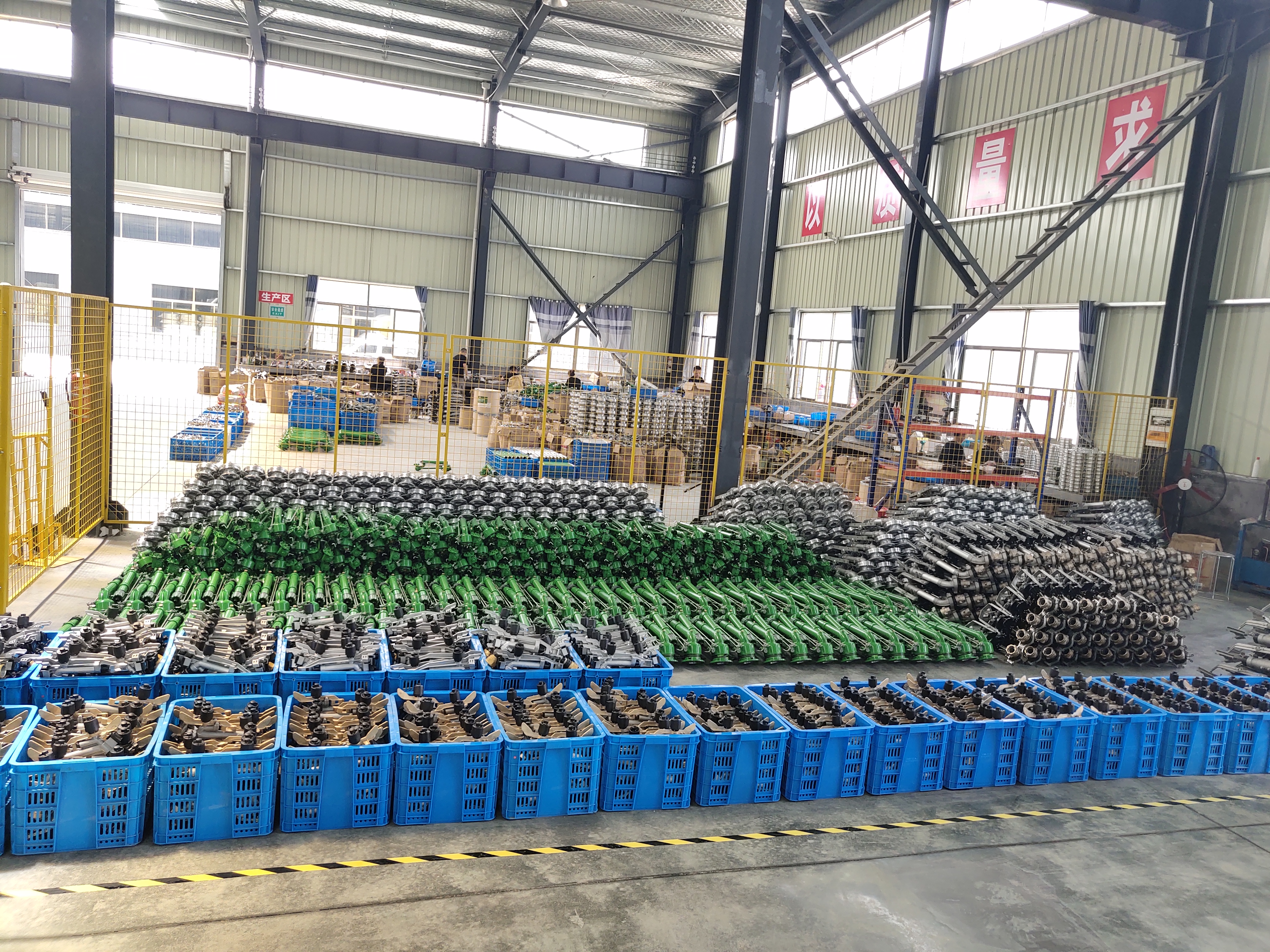
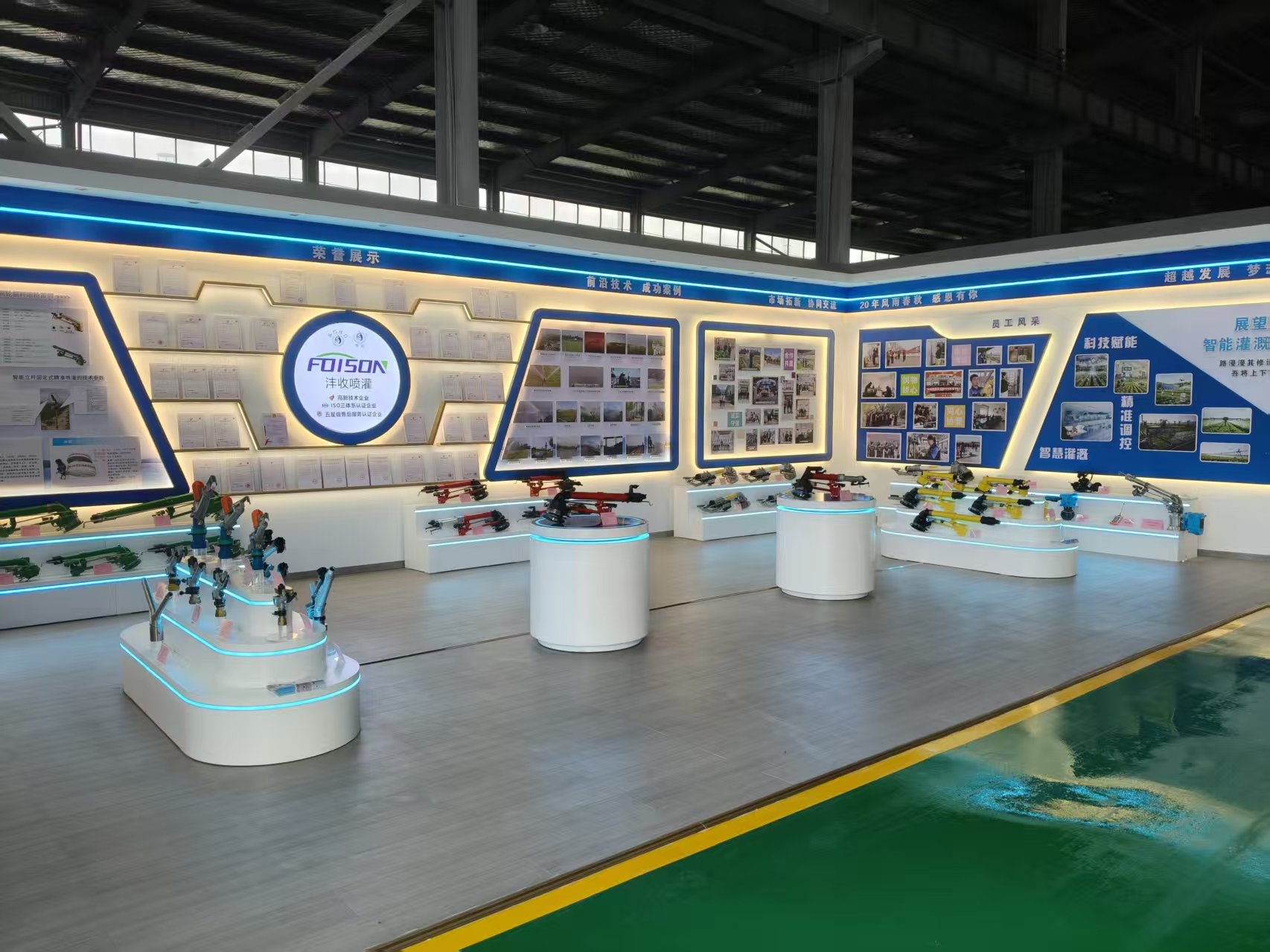
On the supply side, the company was founded in 2013, operates a 30,000 m² factory with 135 staff, and produces 200,000 units a year — a volume that supports wholesale programs rather than one-off shipments. A 12-engineer R&D team supports OEM and custom designs, which matters if a nozzle specification, a connection type or a branded configuration has to be adapted to your market rather than drawn from the standard catalog. A 70% export ratio and distribution across the EU, Africa, Australia, New Zealand, South East Asia, Mid Asia, Mid East and South America indicate a supply chain already organised for export documentation and international logistics. The company operates a showroom and workshop at its Xuzhou facility.
FAQ
Does a rotating rain gun such as the FSN50 or FSC50 have to meet a specific standard?
ISO 7749-1:1995 specifies the design and operational requirements for rotating sprinklers used in agricultural irrigation, and it is the international reference describing what a rotating sprinkler is expected to deliver. Both the FSN50 turbine gun and the FSC50 impact gun are rotating sprinklers with a 360° adjustable arc and a 24° spray angle. On the trade side, appliances of this type for agricultural or horticultural use for projecting, dispersing or spraying liquids generally fall under HS code 842482, which is the classification to verify when preparing import documentation. FOISON Sprinkler ships products accepted through a pre-shipment test procedure; buyers should confirm which standard and which certification evidence their own market requires before the order is placed.
Can one supplier cover both turbine and impact rain guns for a distribution program?
FOISON Sprinkler's core products are turbine spray guns, impact guns and irrigation systems, and its main products are farm and industrial sprinklers suited to distributor ranges. That means the FSN50 turbine gun and the FSC50 impact gun can be sourced from the same manufacturer, on the same terms and with the same spare-parts logic. The company's 12-engineer R&D team supports OEM and custom designs, the factory covers 30,000 m², and annual output is 200,000 units with 135 staff — capacity consistent with wholesale and distribution volumes rather than single-unit supply.
What are the MOQ, payment and delivery terms for a rain gun order?
The minimum order quantity is 20 units. Payment terms are a 30% deposit with the remaining 70% due before shipment. Delivery can be arranged on FOB, CIF or DDP terms. Products are accepted through a pre-shipment test procedure. For an order mixing FSN50 turbine guns and FSC50 impact guns, these terms apply to the shipment as a whole rather than per model.
How do we validate the FSN50 or FSC50 before committing to a full order?
Validation works best in two stages. First, run sample units on your own block through a full irrigation cycle and measure pressure at the gun inlet while it rotates — that reading decides whether the FSN50's 0.2 MPa floor or the FSC50's 0.15 MPa floor is the realistic specification for your supply. Second, use the pre-shipment test procedure as the acceptance check on the shipment itself. Because the MOQ is 20 units, a first order can contain both models, so the low-pressure behaviour of the FSC50 and the rotation behaviour of the FSN50 can be compared under your own operating conditions rather than on a specification sheet. Sample and specification requests can be sent to sales@foison-irrigation.com or +86 186 5822 6303.
What does a long-term sprinkler supplier relationship look like for irrigation equipment distribution?
A long-term arrangement is judged on whether the product range, the export record and the engineering support hold up over several seasons. FOISON Sprinkler was founded in 2013 and now has over 12 years of industry experience, a 30,000 m² factory, 135 staff and an annual output of 200,000 units. Its export ratio is about 70%, with distributors served across the EU, Africa, Australia, New Zealand, South East Asia, Mid Asia, Mid East and South America, and a 12-engineer R&D team supports OEM and custom designs for market-specific requirements. The company has a showroom and workshop, and a downloadable product catalog covering its irrigation equipment range. Distributors can request the catalog and a quotation at foison-irrigation.com.
Conclusion
The FSN50 and the FSC50 answer two different hydraulic situations, and the deciding evidence is already in the specifications. The FSN50 turbine gun covers 0.2–0.7 MPa with a 26–53 m throw and 20 mm or 26 mm nozzle examples, and it is specified where the wetted pattern has to repeat consistently because rotation comes from the turbine rather than from the jet. The FSC50 impact gun covers 0.15–0.7 MPa with a 23–56 m throw and a 14 mm nozzle example delivering 9 m³/h at 0.15 MPa, and it is specified where the supply is low-head and reach matters most. Shared 24° spray angle, 360° adjustability and aluminium, nylon and stainless steel construction mean the two can sit in one program without doubling the service burden.
The practical rule for a final decision: read the pressure at the gun inlet with the block running, set spacing from throw radius, then pick the mechanism whose lowest rated pressure your system actually holds. If the block sits at or below 0.2 MPa and needs reach, the FSC50 is the correct impact gun. If it holds 0.2–0.7 MPa and needs uniformity, the FSN50 is the correct turbine gun. Where a distributor serves both profiles, stocking both is a range decision, not a compromise.
Next step: download the full FOISON Sprinkler product catalog, or send your block pressure, required throw and annual volume to sales@foison-irrigation.com / +86 186 5822 6303 for a model recommendation under MOQ 20 units, 30% deposit and 70% before shipment, FOB, CIF or DDP.
Have Questions or Need More Details?
Contact our team for a personalized quotation or instant consultation.
Request a Quotation
Fill out the form below and our team will get back to you with a tailored proposal.
WhatsApp Direct Chat
Prefer to chat in real-time? Message us on WhatsApp for instant assistance & quick answers.
- Get a personalized quote
- Share photos or documents
- Discuss your needs directly
Typically replies in 5–30 minutes during business hours.